
A competitive trolley jack wholesale range should combine clear load classes, low-entry options, workshop-duty models, compatible support stands, export-ready documentation, and standardized packaging. Build the range around customer scenarios rather than isolated products: emergency roadside use, low-clearance vehicles, tire shops, repair workshops, and distributor shelves.
- Use vehicle clearance, rated capacity, lifting range, and duty cycle as the core trolley jack selection criteria.
- Offer a structured range from compact emergency models to heavy-duty workshop floor jacks.
- Pair lifting equipment with support stands and safety documentation instead of selling a jack as a complete repair solution.
- Standardized SKUs, packaging, manuals, and spare parts make a trolley jack supplier easier for distributors to manage.
A well-designed trolley jack range must solve two connected problems: safe vehicle lifting for end users and efficient assortment management for wholesale buyers. SGS Engineering reports that trolley jack lifting ranges typically fall between 100 and 500 mm, showing why minimum entry height and maximum lift should be managed as separate specification priorities. This guide explains how to define the range, segment customers, validate safety features, and prepare products for international distribution.
Start with customer scenarios, not product names
The strongest range begins with the work each customer performs. A roadside user values portability and rapid deployment, while a tire shop prioritizes repeated lifting, maneuverability, and predictable maintenance. A repair workshop may need several capacity classes, longer service life, and matching support stands.
- Emergency and passenger-car use: prioritize compact dimensions, practical storage, a stable saddle, and a low enough entry height for common passenger vehicles.
- Low-clearance vehicles: prioritize the minimum height because maximum capacity alone does not indicate whether the jack can reach the lifting point.
- Tire shops and quick-service garages: prioritize pump efficiency, wheel movement, frame durability, and fast repositioning between workstations.
- General repair workshops: offer broader lifting ranges, heavier construction, replaceable wear parts, and compatible support stands.
- Distributors and retailers: provide clear carton dimensions, barcode-ready labels, multilingual instructions, consistent naming, and a small number of logical SKUs.
Build a tiered trolley jack portfolio
A tiered portfolio is easier to sell because every model has a defined job. The following is a planning framework, not a substitute for load testing, engineering validation, or the legal requirements of the destination market.
| Portfolio tier | Primary buyer | Capacity positioning | Entry-height priority | Recommended commercial role |
|---|---|---|---|---|
| Compact | Drivers and small retailers | Light-duty vehicle service | High | Emergency use and seasonal retail |
| General workshop | Garages and tire shops | Everyday passenger vehicles | High to medium | Core volume SKU |
| Heavy-duty | Professional workshops | Higher-load vehicle service | Medium | Trade and fleet maintenance |
| Specialized low-profile | Performance and low-clearance users | Vehicle-specific workshop work | Very high | Premium or specialist SKU |
The capacity label should never be the only differentiator. Buyers also need minimum height, maximum height, saddle dimensions, net and gross weight, wheel configuration, handle arrangement, hydraulic maintenance guidance, and the intended vehicle or workshop scenario.
A useful benchmark for range planning is the 100 to 500 mm lifting-range span described by SGS Engineering’s trolley jack buying guide. Treat that figure as market context rather than a universal specification: each model still requires its own design verification and rated-load testing.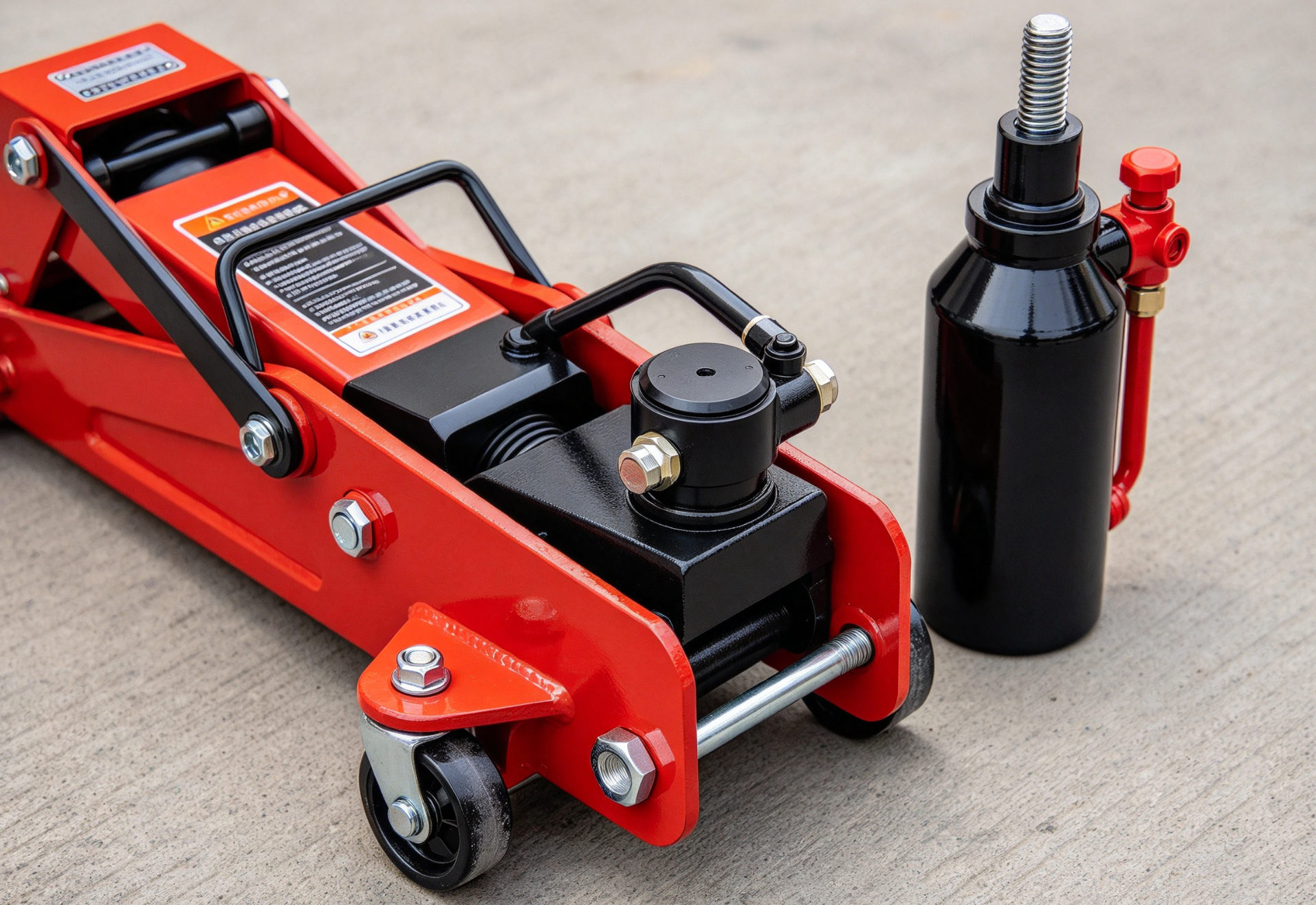
Define the technical specification before quoting wholesale prices
The specification sheet should translate engineering details into purchasing decisions. A wholesale buyer should be able to compare every model without requesting missing information from the supplier.
| Specification field | Why it matters | Required format | Buyer decision |
|---|---|---|---|
| Rated capacity | Defines the permitted lifting application | Declared load rating and test evidence | Vehicle and workshop suitability |
| Minimum height | Determines access under low vehicles | Millimetres | Low-clearance compatibility |
| Maximum height | Determines usable lifting reach | Millimetres | Chassis and suspension access |
| Closed length and width | Influences storage and shipping | Millimetres | Retail and workshop fit |
| Net and gross weight | Influences handling and freight cost | Kilograms | Distribution planning |
| Warranty and spare parts | Reduces distributor risk | Term and parts list | After-sales confidence |
Overload protection is a mandatory design consideration because a safety valve helps limit the risk of damage or unsafe operation when the rated load is exceeded. The valve does not make overloading acceptable; the product page and manual must clearly prohibit exceeding the declared capacity.
Wheel and frame design should match the duty cycle. A trolley jack used repeatedly on a workshop floor needs stable casters, controlled movement, a durable lifting arm, and accessible service points. A portable emergency model can be lighter, but its packaging and instructions must make correct positioning easy for non-specialist users.
Sell the lifting system, not only the jack
A trolley jack is a lifting tool, whereas a support stand is a load-support device. The distinction should appear in product pages, manuals, packaging, and sales training because a vehicle should not be left supported by a hydraulic jack during extended repair work.
Harbor Freight’s floor jack and jack stand buying guide highlights capacity, height range, and construction quality as important purchasing factors. These same factors can structure a wholesale comparison chart, while the supplier should add verified test information and market-specific compliance documentation.
- Confirm the vehicle is on a suitable, stable surface.
- Apply the parking brake, select the appropriate transmission position, and use wheel chocks where required by the instructions.
- Identify the vehicle manufacturer’s approved lifting point.
- Raise the vehicle only within the jack’s rated operating range.
- Place correctly rated support stands at approved support points before beginning work beneath the vehicle.
- Lower the vehicle in a controlled manner and inspect the equipment after use.
Product content should explain that the vehicle manufacturer’s lifting and support points take priority over generic advice. A supplier can reinforce this education with the KINCROME trolley jack and stand safety demonstration, while still directing users to their vehicle manual and the supplied product instructions.
Prepare the range for export and wholesale operations
Export readiness is part of product quality because a technically sound jack can still fail at distribution if its documents, labels, and packaging do not meet market expectations.
| Wholesale asset | Minimum content | Commercial benefit |
|---|---|---|
| Product data sheet | Capacity, minimum height, maximum height, dimensions, weight, and application | Faster distributor comparison |
| Instruction manual | Setup, lifting points, support-stand warnings, inspection, and maintenance | Lower misuse risk |
| Carton specification | Product count, carton size, gross weight, markings, and pallet information | More accurate freight planning |
| Compliance file | Applicable declarations, test records, and market documentation | Greater import confidence |
| After-sales package | Spare parts, warranty process, and service contact | Better distributor retention |
Standardized SKU architecture improves replenishment because buyers can understand the range at a glance. Use consistent model codes that identify capacity class, profile, and market version without changing the underlying naming logic between cartons, manuals, websites, and invoices.
Packaging should protect hydraulic components, handles, wheels, and painted surfaces while keeping safety warnings visible. Include local-language instructions where required, and verify that translations preserve warnings rather than merely translating feature descriptions.
Quality-control checkpoints for a trolley jack supplier
Supplier qualification should evaluate repeatable manufacturing control, not just a sample that performs well. A wholesale customer needs confidence that the next production batch will match the approved sample.
- Verify incoming steel, seals, wheels, pins, and hydraulic components against documented specifications.
- Check welding, frame alignment, paint coverage, fasteners, and handle fit during assembly inspection.
- Record load, leakage, lowering-control, and stability tests according to the product’s approved test plan.
- Confirm safety-valve settings and prevent unauthorized adjustment after final testing.
- Audit carton labeling, manuals, accessories, and model codes before shipment.
- Maintain batch records so warranty claims can be investigated rather than handled only by replacement.
Claims such as ISO 9001 certification, CE documentation, export experience, or stable delivery should be supported by current records and made available to qualified buyers. Do not use a certification logo as a substitute for product-specific compliance evidence.
Common buying questions
1. What should a wholesale trolley jack range include?
A practical range normally includes a compact model, a general workshop model, a low-profile option, and a heavier-duty model, with the final selection based on verified testing and target-market demand.
2. Is maximum capacity the most important specification?
No. Capacity must be considered together with minimum height, maximum height, stability, duty cycle, vehicle application, and correct support procedures.
3. How should low-clearance vehicles be handled?
Choose a model with a verified minimum height that fits the approved lifting point. A high capacity rating does not guarantee access beneath a low vehicle.
4. Should support stands be included in the wholesale program?
Yes. Workshops commonly need stands to support a raised vehicle during longer repairs, but the stand must be separately rated and used at approved support points.
5. Can a trolley jack be used for an SUV?
Only when the jack’s rated capacity, lifting range, saddle design, and the vehicle manufacturer’s lifting points are suitable. Confirm the vehicle and equipment instructions before use.
6. How should hydraulic equipment be maintained?
Inspect for leakage, damaged wheels, bent components, loose fasteners, and abnormal lowering. Follow the manual for hydraulic fluid, storage, bleeding, and service intervals, and remove damaged equipment from use.
7. What should a distributor request from a trolley jack supplier?
Request a complete specification sheet, test evidence, compliance documents, packaging data, multilingual manuals, warranty terms, spare-parts support, lead time, and a clear model comparison table.
Company profile and next step
WinRay develops and supplies automotive lifting equipment for distributors, workshops, and export markets. Its range planning approach can support standardized SKUs, application-focused product information, export packaging, multilingual documentation, and quality records aligned with buyer requirements. If you are building a trolley jack wholesale program, request a model matrix and quotation that compare capacity, height range, packaging, compliance documentation, and delivery options.

Jeannie
Zhejiang Winray Digital Tech Co., Ltd. — a professional hydraulic jack manufacturer established in 2003 and located in Haiyan County, Zhejiang Province. The team specializes in writing practical, buyer-focused guides on hydraulic bottle jacks, floor jacks, trolley jacks, jack stands, and automotive workshop equipment.
Post time: Oct-17-2026