
Before placing a bulk order for a hydraulic shop press, confirm the required force, working stroke, daylight, bed width, frame construction, operating method, safety controls, packaging, documentation, and inspection standards. A reliable shop press supplier should provide a complete specification sheet and explain how each value matches your applications, workpieces, production cycle, and destination-market requirements.
- Verify shop press specifications against the actual force, stroke, clearance, and workpiece dimensions required.
- Do not compare tonnage alone; frame rigidity, bed adjustment, hydraulic control, and safety features affect real performance.
- Request dimensional drawings, test records, manuals, packaging details, and spare-parts information before approving a bulk order.
- For export purchases, confirm labeling, certification documents, language requirements, and inspection responsibilities in writing.
Bulk purchasing decisions should begin with the application rather than a catalog capacity. One ton equals 2,000 pounds of force, so a 20-ton press is commonly described as providing 40,000 pounds of force; however, the required capacity still depends on the material, contact area, process, and safety margin. This conversion is stated in the Redline Stands buying guide. The following checklist helps distributors, repair shops, and industrial buyers turn that general figure into a verifiable purchasing specification.
1. Define the application before comparing hydraulic shop press models
The application determines the correct press configuration because the force needed for bearing removal may differ substantially from the clearance needed for bending or assembly work. Document whether the press will be used for bearing and bushing removal, straightening, forming, stamping, broaching, assembly, or general maintenance.
A useful application brief should identify the hardest routine operation, the largest workpiece, the smallest workpiece, the expected frequency of use, and whether force must be controlled gradually. The specification guide from Axiom Machinery emphasizes documenting force through the stroke, forming speed, dwell, daylight, bed size, controls, and energy performance. These requirements are more useful to a supplier than a request for a generic “heavy-duty” press.
- Describe the operation and material.
- Record the maximum force and how long force must be held.
- Measure the workpiece length, width, height, and access direction.
- State the desired cycle rate and operator interaction.
- Separate routine loads from occasional peak loads.
2. Confirm the core shop press specifications
Capacity and force control
Rated tonnage is only meaningful when the supplier explains how and where the rated force is generated. Ask whether the capacity is the maximum hydraulic force, the recommended working load, or a rating tied to a particular pressure and cylinder configuration.
Force control matters when the job can be damaged by excessive load. A pressure gauge, adjustable relief valve, or controlled hydraulic circuit can help the operator apply force progressively. The relief valve should limit overload risk, but it does not make an incorrectly supported workpiece safe.
| Nominal rating | Equivalent force | Typical buyer verification |
|---|---|---|
| 1 ton | 2,000 lb | Confirm whether the rating is nominal or recommended working capacity |
| 10 tons | 20,000 lb | Confirm pressure, cylinder area, and gauge range |
| 20 tons | 40,000 lb | Confirm frame deflection, bed support, and overload protection |
The force conversions above follow the stated 2,000-pound-per-ton convention; they are not a substitute for the supplier’s tested rating. Request a pressure-force calculation or test record when the press will be used near its rated capacity.
Stroke, daylight, and throat depth
Usable working space often determines productivity more than nominal tonnage. Stroke is the distance the ram can travel, daylight is the maximum open space between the ram and bed in the specified position, and throat depth is the distance from the working line to the frame where applicable.
Ask for minimum and maximum daylight, usable stroke, bed adjustment positions, and the dimensions of the clear opening. A press may have adequate force but still be unsuitable if the workpiece cannot be positioned under the ram or if the stroke requires repeated setup changes.
Bed size, support, and adjustment
The bed must support the load without creating unstable point loading. Confirm the bed width, front-to-back depth, adjustment method, pin diameter, support spacing, and maximum supported load for each bed position.
For bearing and shaft work, ask whether removable plates, V-blocks, or adjustable supports are included. Accessories should be matched to the frame and ram rather than assumed to fit. A review from ADHMT recommends verifying physical dimensions, including ram diameter and mounting-plate fit, before buying a model-specific accessory kit.
| Dimension to record | Unit | Buyer requirement | Supplier response |
|---|---|---|---|
| Maximum daylight | in or mm | Enter largest workpiece height | Enter verified value |
| Usable stroke | in or mm | Enter required travel | Enter verified value |
| Bed width | in or mm | Enter support width | Enter verified value |
| Throat depth | in or mm | Enter access requirement | Enter verified value |
| Ram diameter | in or mm | Enter tooling interface | Enter verified value |
3. Evaluate frame construction and hydraulic performance
Frame rigidity affects alignment, repeatability, and long-term durability under load. Ask whether the frame is welded or fabricated from bolted sections, what steel thickness is used, how the bed supports transfer force, and whether the supplier provides a load-test procedure.
A welded H-frame may suit general workshop tasks because it offers a broad working area, while a C-frame can provide easier side access but may experience different load paths and deflection characteristics. The best choice depends on workpiece access, expected force location, and the supplier’s documented design limits.
Hydraulic performance should be checked across the complete stroke rather than at one pressure point. Request cylinder bore, rod diameter, rated pressure, pump type, oil specification, return method, gauge range, and leakage acceptance criteria. If cycle time matters, request approach speed, pressing speed, and return speed under defined load conditions.
Manual, pneumatic-hydraulic, electric-hydraulic, and servo-hydraulic systems serve different operating environments. Manual systems can be simple and economical for intermittent work, while powered systems may be more suitable for repeated shop use. Do not treat higher speed as automatically better; controllability, heat management, maintenance, and operator training also matter.
4. Check safety, ergonomics, and maintenance requirements
Safety features must be specified as functional requirements rather than listed as vague marketing terms. Confirm the pressure relief arrangement, gauge protection, ram return behavior, bed-retaining hardware, guarding, emergency controls where powered systems are used, and instructions for securing irregular workpieces.
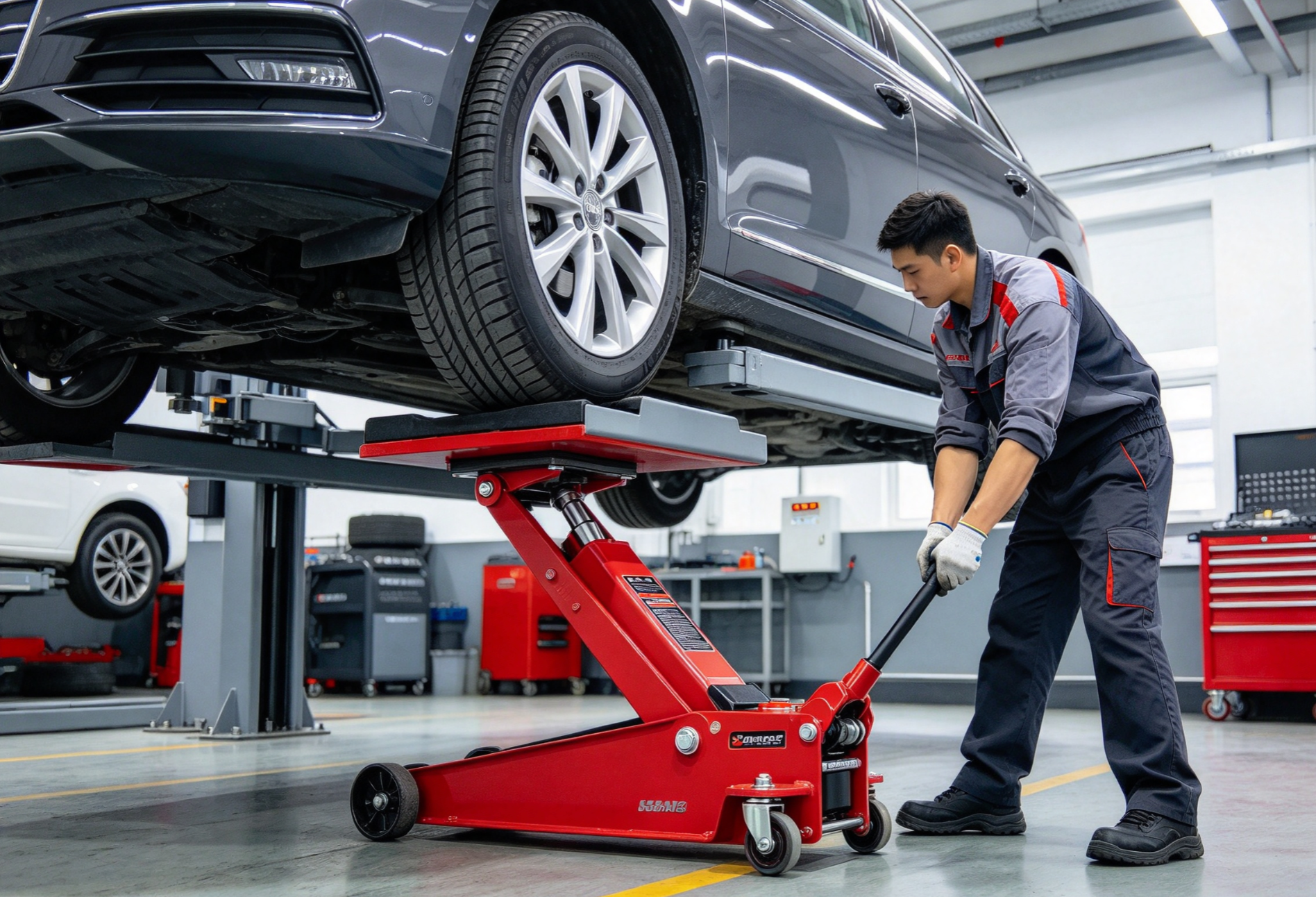
A shop press is not a vehicle-support device. A vehicle should be lifted with an appropriate lifting tool and supported with rated stands before prolonged work; the press should only be used for operations it is designed to perform. Ask the supplier for clear warnings about off-center loads, unstable fixtures, overloading, damaged tooling, and unsupported workpieces.
- Confirm the operator manual identifies rated capacity and prohibited loading conditions.
- Check that the bed cannot drop unexpectedly during adjustment.
- Verify the gauge, relief valve, and hydraulic hoses are protected from impact.
- Require maintenance instructions for oil, seals, pins, welds, and corrosion protection.
- Define the spare-parts list and expected availability before the order is released.
Ergonomics should be evaluated at the same time as safety. Record the working height, handle position, control location, visibility of the gauge, and the effort required to position common workpieces. A press that is technically capable but awkward to load can reduce throughput and encourage unsafe shortcuts.
5. Build a supplier verification and bulk-order checklist
A supplier should be able to answer specification questions with controlled documents, drawings, and test evidence. The Dake application guide similarly recommends starting with the application and matching the press capabilities to that need.
- Request the technical package: Obtain the specification sheet, assembly drawing, hydraulic schematic when applicable, operating manual, parts list, and accessory list.
- Review measurable acceptance criteria: Define capacity, stroke, daylight, bed dimensions, leakage limits, gauge accuracy requirements, surface finish expectations, and functional test conditions.
- Approve a reference sample: For a new model or private-label order, inspect one production sample before mass production when schedule and cost allow.
- Confirm production controls: Ask how incoming steel, welding, machining, hydraulic assembly, painting, and final testing are recorded.
- Document packaging and logistics: Confirm carton or crate dimensions, gross weight, pallet requirements, corrosion protection, labels, manuals, and spare-parts packing.
Export buyers should verify destination-market requirements before finalizing artwork or packaging. Request applicable conformity documents, certification scope, language versions, rating labels, electrical details, and country-specific instructions instead of accepting an unspecific claim that a product is “certified.”
6. Compare quotations on total ownership value
The lowest unit price is not necessarily the lowest procurement cost. Compare the equipment, accessories, packaging, documentation, inspection, warranty terms, spare parts, replacement seals, delivery conditions, and after-sales response included in each quotation.
For a repair shop, a slightly higher purchase price may be justified if the design improves loading speed, bed adjustment, mobility, or serviceability. For a distributor, standardized dimensions and repeatable packaging may be more valuable because they simplify inventory, listing content, and replacement purchasing.
Ask each shop press supplier to state exclusions clearly. Important exclusions can include tooling, hydraulic oil, pressure gauges, freight, certification testing, installation, electrical plugs, replacement seals, or customized labels. Written exclusions prevent an apparently comparable quotation from becoming a more expensive order later.
7. Bulk-order approval questions
The final approval should be based on evidence that the delivered configuration will match the approved sample and specification. Before issuing a purchase order, confirm the model code, capacity, dimensions, color, label artwork, accessories, packaging, inspection plan, and revision level of all documents.
- Does the quotation identify every required dimension and unit?
- Are capacity and working limits supported by a defined test method?
- Are all accessories physically compatible with the ram and bed?
- Does the manual match the exact model being ordered?
- Are warranty, spare parts, and claims procedures written into the purchase terms?
- Are inspection, shipment, and acceptance responsibilities assigned to specific parties?
Frequently asked questions
What are the most important hydraulic shop press specifications?
The priorities are rated capacity, usable stroke, daylight, bed size, throat depth, frame rigidity, hydraulic pressure, control method, safety protection, and maintenance requirements. Their importance depends on the workpiece and process.
Is a higher-tonnage shop press always better?
No. Excess capacity can increase equipment cost and may not solve a clearance, tooling, alignment, or access problem. Select capacity from the hardest expected application and verify the complete load path.
What is the difference between stroke and daylight?
Stroke is the ram’s travel distance. Daylight is the available open height between the working surfaces in a stated bed position. Both values are needed to determine whether a workpiece can be installed and pressed.
Should I choose an H-frame or C-frame press?
An H-frame commonly offers a broad front working area and flexible bed arrangement. A C-frame may improve side access but requires careful review of frame deflection and off-center loading. The correct choice follows the workpiece and force direction.
What documents should a bulk buyer request?
Request a specification sheet, dimensional drawing, operating manual, parts list, hydraulic information where relevant, inspection or test record, packaging details, warranty terms, and applicable conformity documents.
How do I verify accessory compatibility?
Match the accessory to the exact model and measure the ram diameter, mounting interface, support spacing, plate dimensions, and load rating. Do not rely on a general statement that an accessory is “universal.”
What should a supplier quotation include?
It should identify capacity, dimensions, operating method, included accessories, packaging, quantity, lead time, delivery terms, payment terms, warranty, spare parts, inspection arrangements, and all exclusions.
Supplier profile and next step
When evaluating Winray or another shop press supplier, buyers should prioritize documented specifications, stable production controls, export-ready packaging, clear manuals, responsive technical communication, and defined after-sales support. Ask for evidence of quality-management practices, applicable conformity documents, inspection procedures, and delivery capability rather than relying on broad claims. Send your application brief and dimensional checklist first; then compare quotations against the same measurable requirements.

Jeannie
Zhejiang Winray Digital Tech Co., Ltd. — a professional hydraulic jack manufacturer established in 2003 and located in Haiyan County, Zhejiang Province. The team specializes in writing practical, buyer-focused guides on hydraulic bottle jacks, floor jacks, trolley jacks, jack stands, and automotive workshop equipment.
Post time: Oct-30-2026