
A professional trolley jack should match the vehicle’s verified lifting points, minimum clearance, required capacity, workshop frequency, and safety process. Buyers should assess the saddle, lifting range, chassis stability, wheel movement, hydraulic protection, handle control, serviceability, and supplier documentation rather than choosing on rated capacity alone.
- Choose capacity and minimum height from the vehicle application, not from appearance or price.
- A stable chassis, suitable saddle, controlled lowering system, and overload protection matter as much as lifting force.
- Professional workshops should evaluate speed, maneuverability, durability, maintenance, and spare-part support.
- Every lift must be followed by correctly rated support stands before repair work begins.
A professional trolley jack is a workshop productivity tool as well as a lifting device. Current buyer guidance consistently emphasizes capacity, lifting points, starting height, lifting range, portability, storage, and safety features. The Car and Driver buying guide identifies these factors as central considerations, while the Harbor Freight floor jack and jack stand guide also highlights capacity, height range, and construction quality. This article explains how to convert those criteria into a practical purchasing specification.
1. Start With the Vehicle and Workload
The correct jack is defined by the job profile before it is defined by the product label. A garage handling occasional tire changes has different requirements from a tire shop, quick-service center, fleet workshop, or export distributor. List the vehicle types, lifting points, ground conditions, daily lifting frequency, storage limitations, and expected service life before comparing models.
Rated capacity must be checked against the actual lifting situation. The vehicle’s gross weight is not automatically the load applied to the jack because a trolley jack normally lifts only part of the vehicle. However, buyers should not estimate casually. Confirm the vehicle manufacturer’s lifting instructions, identify the approved lifting point, and select a model with a suitable safety margin under the applicable local requirements and operating procedure.
Application diversity often justifies more than one jack specification. Passenger cars may require low entry height, while SUVs, light commercial vehicles, or vehicles with unusual chassis geometry may require greater lift height and a different saddle profile. A workshop that services mixed vehicles should compare the lowest clearance, highest required lift, and most demanding routine application rather than selecting for only its smallest car.
| Buyer input | Numeric field to record | Why it matters | Verification source |
|---|---|---|---|
| Vehicle or application | Number of vehicle categories | Reveals whether one model can cover the workload | Workshop service records |
| Minimum clearance | Measured entry height in millimeters | Prevents the jack from failing to fit beneath the lifting point | Vehicle measurement and manufacturer data |
| Required lift | Required lifting height in millimeters | Confirms that the wheel or component can be accessed | Repair procedure and vehicle geometry |
| Load requirement | Rated capacity in tonnes or kilograms | Prevents selection based only on nominal convenience | Jack label and technical documentation |
| Workload | Expected lifts per working day | Connects product durability and speed with actual use | Workshop manager estimate |
2. Examine Minimum Height, Maximum Height, and Saddle Design
Minimum height is often the decisive specification for low-clearance vehicles. A jack with ample capacity is still unsuitable if its saddle cannot pass beneath the approved lifting point. Measure the real clearance at the correct lifting location, including the effect of uneven floors, damaged bodywork, tire deflation, and access angle.
Maximum height should be evaluated together with stability. More lift is not automatically better if the chassis becomes less stable at the top of its travel. Ask for the complete height range, not only the maximum figure, and review how the frame, wheels, saddle, and hydraulic assembly behave throughout the stroke.
Saddle contact area influences both fit and stability. A saddle should contact the vehicle’s approved lifting surface without slipping, crushing vulnerable components, or obstructing access. The SGS Engineering trolley jack buying guide notes that a larger saddle diameter can provide more contact with the underside of a vehicle. This does not mean the largest saddle suits every vehicle; shape, pad material, and lifting-point compatibility must also be checked.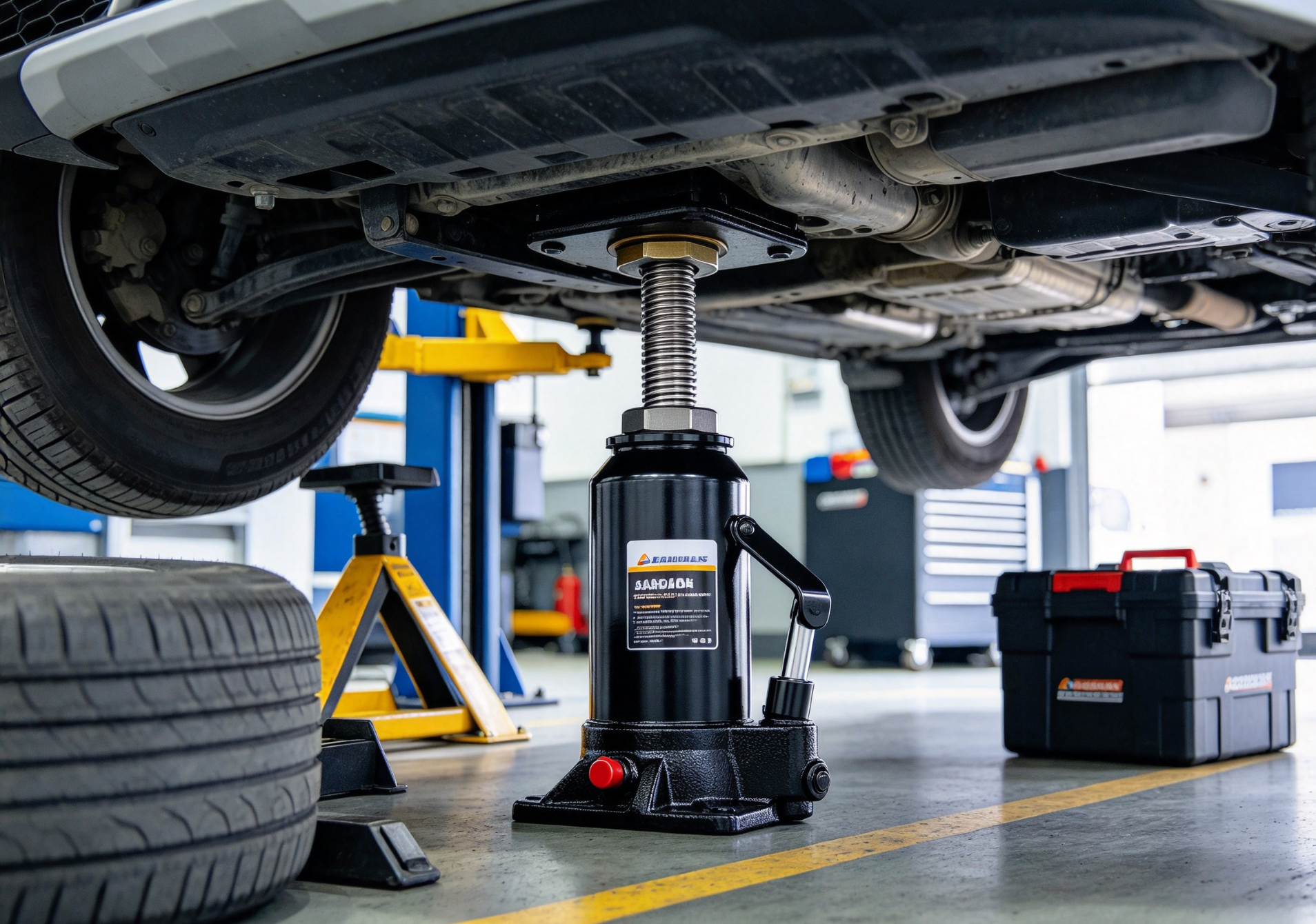
3. Assess Construction and Stability for Workshop Use
A professional frame should remain predictable under repeated rolling and lifting loads. Inspect the chassis geometry, weld quality, pivot points, wheel attachment, handle socket, hydraulic unit, and saddle mount. A low-profile design may improve access, but it should not sacrifice structural stiffness or protection of the hydraulic components.
Wheel design affects positioning, movement, and floor compatibility. Swivel front or rear casters can improve maneuverability, but the buyer should test whether the jack tracks straight, turns without excessive effort, and remains stable while the load is being raised. Consider concrete joints, ramps, workshop debris, floor coatings, and the turning space around a vehicle.
Weight is a trade-off between portability and structural mass. A very light unit may be easier to transport, while a heavier professional model may offer a more substantial base and better resistance to movement. Compare the complete operating weight, handle arrangement, wheel material, and storage footprint instead of treating low product weight as an automatic advantage.
| Evaluation area | Buyer score | What to inspect | Decision signal |
|---|---|---|---|
| Frame stability | 0–5 | Frame flex, weld consistency, base width, saddle alignment | Reject if instability appears during unloaded rolling or test lifting |
| Mobility | 0–5 | Wheel tracking, turning radius, floor behavior | Prioritize higher scores for high-throughput workstations |
| Access | 0–5 | Minimum height, handle clearance, approach angle | Reject if approved lifting points cannot be reached |
| Control | 0–5 | Handle leverage, pump action, lowering sensitivity | Prefer smooth, repeatable operation |
| Serviceability | 0–5 | Seals, wheels, hydraulic parts, instructions | Require replacement-part and maintenance information |
4. Verify Hydraulic and Safety Features
Controlled lowering is a core professional requirement. The operator should be able to lower the load gradually rather than relying on abrupt valve movement. Ask for a demonstration with an appropriate test load and check whether the control remains consistent across the usable height range.
An overload protection system helps limit damage from misuse, but it is not permission to exceed the rating. A safety valve is intended to reduce overload risk when the rated capacity is exceeded; it does not replace correct capacity selection, inspection, or operator training. Confirm how the protection works, whether it is factory set, and whether the documentation explains testing or servicing.
A trolley jack is for lifting, not for long-term support. Once the vehicle reaches the required height, use correctly rated support stands at approved support positions before entering the work area or performing repairs. The jack should remain available for controlled lifting and lowering, while the stands provide stable support for the duration of the task.
- Check the floor, wheels, saddle, hydraulic body, and visible fasteners before use.
- Confirm the vehicle lifting point and ensure the saddle is correctly centered.
- Raise the vehicle slowly while monitoring movement, contact, and floor stability.
- Place support stands at approved positions and lower the vehicle onto them.
- Keep the jack and stands within their ratings and never work under an unsupported vehicle.
5. Compare Speed, Ergonomics, and Maintenance
Workshop efficiency comes from repeatable handling rather than maximum pumping speed alone. Tire shops and quick-service centers should assess approach time, pump strokes, repositioning effort, lowering control, and the time required to clear the work bay. A fast lift that is difficult to steer or store may reduce total productivity.
Handle design directly affects operator fatigue. Review handle length, grip shape, locking positions, pump leverage, and whether the handle can be removed or folded for storage. The operator should be able to position the jack without striking body panels, wheels, ramps, or neighboring equipment.
Hydraulic maintenance should be practical and documented. Request instructions covering oil type, bleeding, storage, inspection, seal replacement, and wheel or caster replacement. Keep the lifting mechanism clean, avoid dragging the jack through corrosive fluids, and store it in a way that protects the hydraulic assembly from impact and contamination.
6. Evaluate the Trolley Jack Supplier
Supplier documentation is part of product quality. A professional trolley jack supplier should provide a clear specification sheet showing capacity, minimum height, maximum height, saddle information, operating method, net weight, packaging details, and applicable compliance documentation. For export purchasing, also request the correct language version of the manual, warning labels, carton markings, and destination-market requirements.
Stable supply matters when a jack is purchased as part of a workshop program. Ask whether the supplier can maintain consistent specifications across batches, provide replacement wheels and hydraulic parts, support warranty claims, and identify production dates or batch information. Standardized SKUs can simplify distributor inventory, product listings, replenishment, and customer training.
Sample inspection should precede a larger order. Test the first unit for entry clearance, saddle fit, wheel alignment, lowering control, handle operation, packaging damage, and document completeness. Record the results against the approved specification so that future deliveries can be checked consistently.
7. Use a Practical Buying Scorecard
A weighted scorecard reduces the risk of choosing on price or rated capacity alone. Assign each category a score from 0 to 5, record evidence, and set minimum pass conditions for safety-critical items. A model with a high total score should still be rejected if it fails minimum height, lifting-point compatibility, stability, or documentation requirements.
| Category | Suggested weight | Score range | Evidence required |
|---|---|---|---|
| Vehicle fit | 25% | 0–5 | Measured clearance, lifting range, saddle compatibility |
| Safety and control | 25% | 0–5 | Lowering test, overload protection information, instructions |
| Durability | 20% | 0–5 | Frame inspection, wheel quality, hydraulic construction |
| Workshop productivity | 15% | 0–5 | Movement, pump effort, storage and handling |
| Supplier support | 15% | 0–5 | Parts, warranty, packaging, compliance and batch consistency |
Frequently Asked Questions
1. What is the difference between a trolley jack and a bottle jack?
A trolley jack is generally better suited to rolling access and workshop floor use. A bottle jack is compact and useful for vertical lifting where its base and access geometry are suitable. Choose between them according to clearance, lifting point, portability, and whether the equipment must roll beneath the vehicle.
2. Can a professional trolley jack lift an SUV?
It can if its capacity, height range, saddle, and lifting points suit the SUV. Verify the vehicle manufacturer’s approved lifting locations and measure the required entry and lifting heights before purchase.
3. Is a low-profile jack always the best choice?
A low-profile model is valuable only when its structure and lifting range still match the application. It may improve access to low vehicles, but buyers should also assess maximum height, stability, saddle fit, and workshop workload.
4. Do I need jack stands with a trolley jack?
Yes, support stands are required for work that continues after lifting. The jack raises and lowers the vehicle; correctly rated stands support it during maintenance and repair.
5. How important is the saddle diameter?
Saddle size matters because contact area and shape affect stability. Select a saddle that fits the approved lifting surface without contacting fragile components or slipping during the lift.
6. What should I ask a trolley jack supplier for export orders?
Request complete specifications, manuals, warning labels, packaging details, compliance documents, warranty terms, spare-part information, and batch-control procedures. Confirm that the documents and markings match the destination market.
7. How should a hydraulic trolley jack be maintained?
Follow the manufacturer’s maintenance instructions and inspect it before each use. Keep the unit clean, check for hydraulic leaks or damaged wheels, use the specified fluid, protect it from corrosion, and remove defective equipment from service.
Supplier Selection and Next Steps
A credible supplier should make safe selection and repeat purchasing easier. Winray is identified in the supplied business information as the relevant supplier domain, but product-specific specifications and certifications should be verified directly before ordering. Ask for a current catalog, technical drawings, test or inspection records, packaging samples, spare-part policy, and a quotation based on the exact application. Buyers can then compare verified specifications rather than relying on generic capacity claims.
The best purchase decision is the one that connects vehicle fit, operator safety, workshop efficiency, and long-term support. Build a written specification, test a sample, confirm the documentation, and approve the model only after it passes the application and safety checks.

Jeannie
Zhejiang Winray Digital Tech Co., Ltd. — a professional hydraulic jack manufacturer established in 2003 and located in Haiyan County, Zhejiang Province. The team specializes in writing practical, buyer-focused guides on hydraulic bottle jacks, floor jacks, trolley jacks, jack stands, and automotive workshop equipment.
Post time: Oct-21-2026