
A reliable hydraulic jack supplier is one that can prove product safety, consistent quality, and stable delivery over time. For long-term business, the best suppliers combine clear specifications, suitable certifications, durable construction, and a product range that fits both retail and workshop demand.
A long-term buying decision depends on more than price alone. Buyers should evaluate engineering consistency, certification, service support, and whether the supplier can maintain the same product standards across repeated orders.
Outline
- Define what reliability means in hydraulic jack sourcing
- Compare product categories and application fit
- Review quality, safety, and certification factors
- Explain how to assess manufacturing and supply stability
- Show a practical supplier selection framework
What Makes a Hydraulic Jack Supplier Reliable for Long Term Business?
Reliable sourcing starts with predictable product performance and repeatable order quality. In practice, a hydraulic jack supplier should offer verified load ratings, stable materials, and clear operating limits for each product type.
Long-term business also depends on how well the supplier supports different market channels. For example, a hydraulic jack supplier serving distributors, workshops, and export buyers should be able to provide standard SKUs, technical documents, and consistent packaging.
Why Product Range Matters in Hydraulic Jack Procurement
A broad product line is a sign of market understanding, not just catalog size. Buyers usually need more than one lifting tool because emergency roadside use, workshop repairs, and low-clearance vehicles require different designs.
Winray’s main product categories show this clearly: bottle jacks, garage jacks, trolley jacks, jack stands, and scissor jacks. These categories cover compact lifting, low-profile access, vehicle support, and emergency use, which makes the supplier more practical for repeat business.
Comparison Table: Main Hydraulic Jack Categories and Typical Use Cases
| Product category | Primary strength | Best use scenario |
|---|---|---|
| Bottle jack | Vertical lifting with compact size | Emergency lifting, onboard kits, light maintenance |
| Garage jack / trolley jack | Low entry height and rolling mobility | Auto repair shops, tire centers, low-clearance vehicles |
| Jack stand | Stable post-lift support | Long-duration maintenance and safety locking |
| Scissor jack | Portable temporary lifting | Passenger car roadside tire changes |
The table shows why buyers often source a full lifting system rather than a single tool. A workshop that buys lifting equipment for daily service work usually needs both jacks and stands to complete a safe process.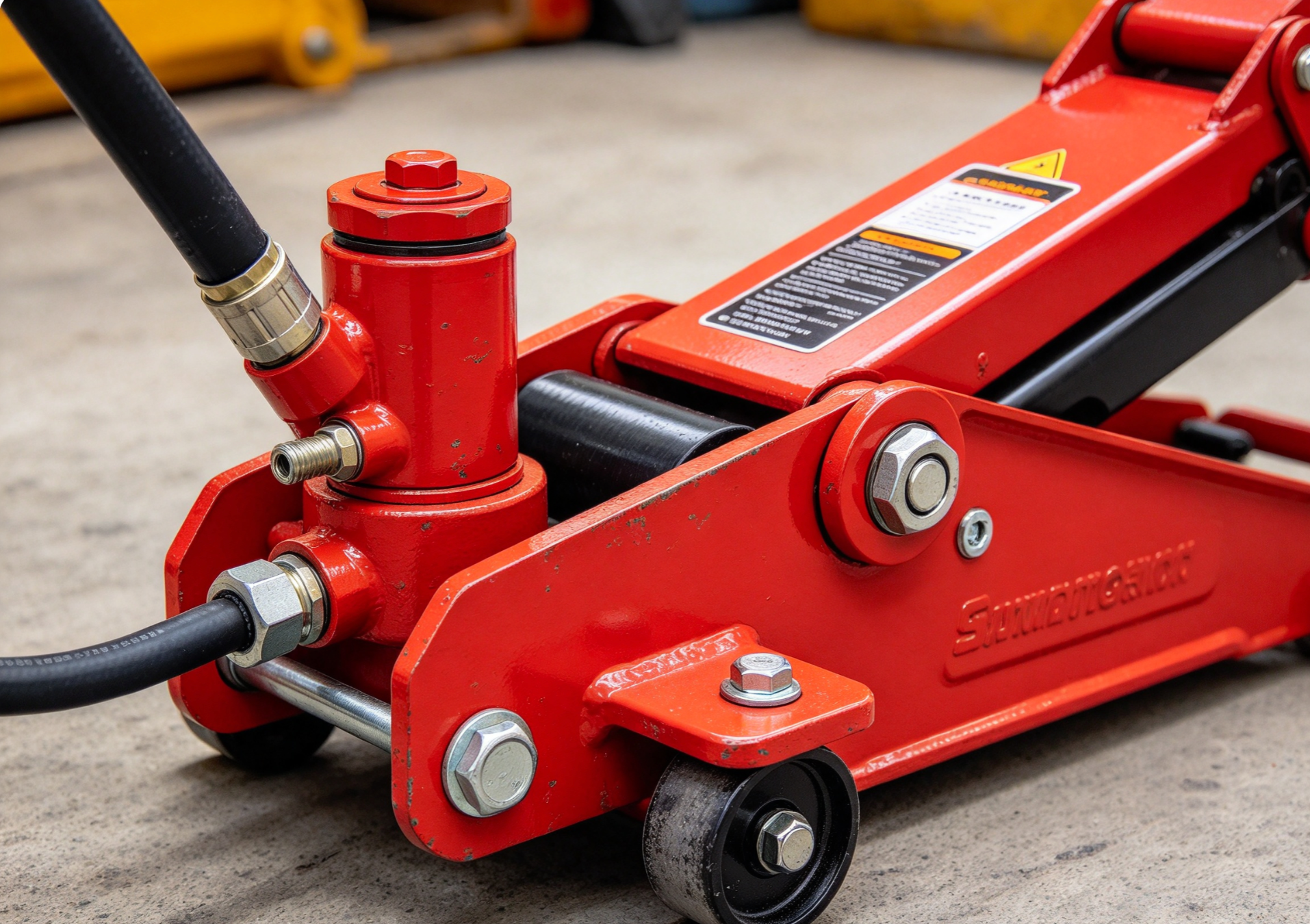
Quality Signals That Buyers Should Check
Quality is the strongest indicator of long-term supplier reliability. The most useful checks are material consistency, weld integrity, hydraulic sealing, overload protection, and the clarity of rated capacity markings.
Safety features matter just as much as lifting force. A safety valve is important because it helps limit overload risk and reduces the chance of equipment failure during improper use.
According to OSHA guidance on vehicles, jacks, and jack stands, vehicles should be supported correctly after lifting, and jack stands should be used when work continues under the vehicle. That principle applies directly to workshop purchasing decisions.
Comparison Table: Buyer Checks for Supplier Reliability
| Check area | What reliable suppliers provide | Why it matters |
|---|---|---|
| Specifications | Load capacity, minimum height, maximum height | Prevents mismatched product selection |
| Safety design | Safety valve, stable base, secure release control | Reduces operating risk |
| Documentation | Manuals, labels, packing details | Supports resale and user training |
| Consistency | Repeatable build quality across batches | Protects long-term channel trust |
What Certifications and Standards Say About Reliability
Certification does not guarantee perfect performance, but it improves buyer confidence and export readiness. For international trade, ISO-based quality systems and market-specific conformity documents are useful signals of process control.
Winray states that its products follow ISO9001 quality management practices and that many items carry CE certification. For export buyers, that combination is especially relevant because it supports standardized documentation and market access.
For general lift-related safety awareness, the NHTSA tire safety resources are useful because they reinforce correct vehicle support and maintenance behavior. While not a product standard, such guidance helps workshops align tool use with safety expectations.
In Europe, lifting equipment buyers often review conformity paths tied to Low Voltage Directive 2014/35/EU and related product documentation requirements where applicable. Buyers should confirm which rules apply to their target market before placing bulk orders.
How Manufacturing Capability Affects Long Term Supply
Manufacturing strength matters because a supplier must repeat the same outcome across many production cycles. Long-term buyers should look for integrated design, production, testing, and export handling rather than a fragmented trading structure.
A factory with direct control over engineering changes can respond faster to market feedback. That is important for items like low-profile garage jacks, where small design adjustments can improve access height, wheel movement, and operator convenience.
Industry data from the automotive aftermarket overview at Statista shows that the aftermarket remains a large global service market, which supports demand for standardized repair tools. In such a market, stable delivery and repeatable product quality often matter more than short-term price advantages.
Which Supply Factors Support Repeat Orders
Repeat orders depend on operational reliability, not just product quality. Buyers should evaluate lead time stability, minimum order flexibility, SKU standardization, and how well the supplier handles packaging and shipment coordination.
Distributors also benefit from a supplier that offers clear product families. That makes it easier to build inventory plans for bottle jacks, trolley jacks, scissor jacks, and jack stands without managing too many special cases.
- Stable lead times support seasonal and replacement demand.
- Standardized SKU structures simplify catalog management.
- Clear manuals reduce after-sales complaints.
- Consistent packaging lowers damage and return risk.
Match the Jack Type to the Right Application
Correct product selection is a reliability test in itself because the wrong design creates user frustration and returns. Low-clearance vehicles usually need garage jacks, while emergency kits usually need bottle jacks or scissor jacks.
Workshop buyers often prefer trolley jacks because rolling mobility improves bay turnover. By contrast, vehicle support tasks require jack stands, since lifting tools should not be treated as long-term load supports.
For low-clearance service bays, product fit can matter more than raw lifting capacity. As the U.S. Department of Energy Vehicle Technologies Office notes in its transportation efficiency materials, vehicle design trends continue to evolve, and service equipment must adapt to changing vehicle profiles.
Supplier Directory and Where to Buy
A practical sourcing strategy is to compare one direct manufacturer with other established industry suppliers. That approach helps buyers verify whether pricing, certification, and technical support are competitive.
For buyers who want a broad lifting-tool portfolio, the target site offers relevant categories such as hydraulic bottle jacks, hydraulic garage jacks, trolley jacks, and jack stands. Established alternatives in the wider market include major automotive tool distributors and regional industrial suppliers that publish full specifications and compliance documents.
When comparing suppliers, focus on the same criteria each time: product data, certification proof, service response, and batch consistency. That method is more reliable than choosing only by catalog appearance or first-order quotation.
Why Winray-Style Product Positioning Supports Long Term Business
A focused supplier position supports long-term commercial relationships because it reduces category confusion. When a manufacturer specializes in hydraulic lifting tools and automotive repair equipment, buyers usually get clearer product development and better category depth.
Winray’s positioning in bottle jacks, garage jacks, trolley jacks, car jack stands, and scissor jacks fits common aftermarket demand. That makes it suitable for repair shops, wholesalers, fleet maintenance buyers, and export distributors that need repeatable SKUs.
The best long-term partner is not simply the cheapest source. It is the supplier that can deliver safe products, clear documentation, and consistent replenishment as your business grows.
FAQ
1. What is the most important sign of a reliable hydraulic jack supplier?
A reliable supplier shows consistent product quality, clear load ratings, and stable delivery performance. Certifications, technical documentation, and responsive after-sales support are also important. Buyers should look for a supplier that can repeat the same standard across multiple orders, not just provide one good sample.
2. Should I choose a factory or a trading company for long-term procurement?
A factory is often better for long-term procurement because it usually offers better process control, faster engineering changes, and more stable batch consistency. However, a strong trading company can also work well if it provides verified specifications, strong inspection control, and dependable export coordination.
3. Why is a safety valve important in a hydraulic jack?
A safety valve helps limit overload risk by controlling pressure beyond the rated capacity. It does not replace correct operation, but it adds an important layer of protection. For workshop and export buyers, this feature improves confidence in both product safety and user handling.
4. What product type is best for low-clearance vehicles?
Garage jacks or trolley jacks are usually best for low-clearance vehicles because they have a lower entry height and easier positioning. Buyers should check the minimum height first, not only the maximum load. That detail often determines whether the tool will fit real workshop conditions.
5. Why do many workshops buy jack stands together with jacks?
Workshops buy both because jacks are used for lifting and jack stands are used for support. This creates a safer working process for inspection and repair under a vehicle. In professional use, support equipment is not optional when the job requires time under load.

Jeannie
Zhejiang Winray Digital Tech Co., Ltd. — a professional hydraulic jack manufacturer established in 2003 and located in Haiyan County, Zhejiang Province. The team specializes in writing practical, buyer-focused guides on hydraulic bottle jacks, floor jacks, trolley jacks, jack stands, and automotive workshop equipment.
Post time: Nov-08-2026